
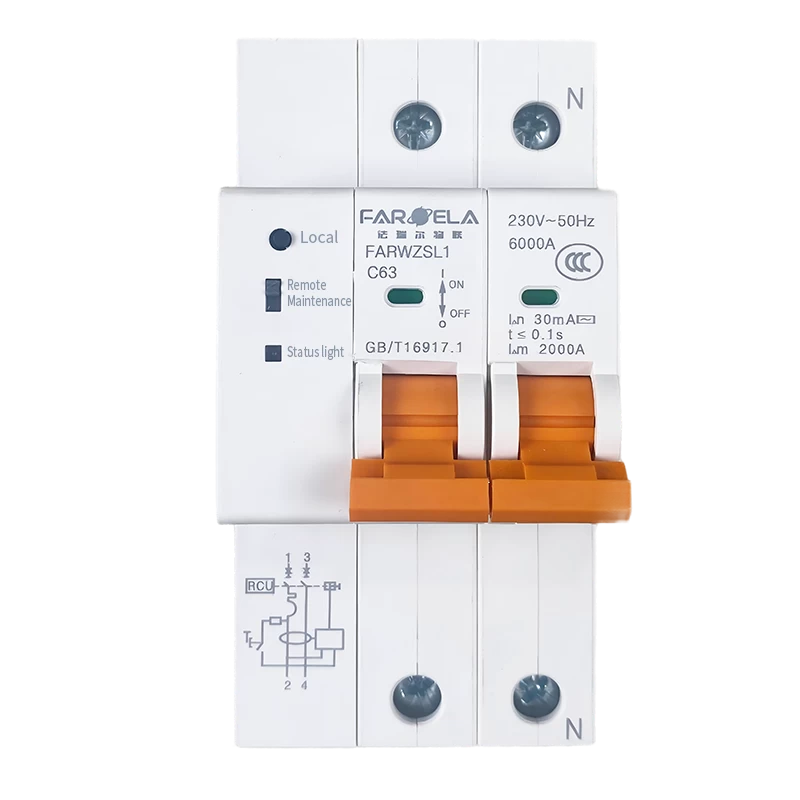
Overcurrent protection - the classic circuit breaker - protects cables and equipment. It does not, on its own, protect people. A person receiving an electric shock draws a current far too small to trip a 16A or 32A overcurrent device, yet more than enough to be lethal. Earth leakage protection exists to close that gap, and no modern electrical installation should be without it.
1. The Principle: Measuring What Comes Back
A residual current device places a current transformer around all live conductors of the circuit - phase and neutral together. In a healthy circuit the current flowing out on the phase equals the current returning on the neutral, so the magnetic fields cancel and the transformer sees zero. If some current escapes to earth through a person or through damaged insulation, the two currents no longer balance. That imbalance is the residual current, and the device trips when it exceeds the set threshold.
This is why the protection depends on a functioning earth path. In an installation with poor earthing, the residual current may not develop as expected - the device is part of a system, not a standalone guarantee.
2. RCCB vs. RCBO: The Choice That Defines Your Panel
- RCCB (residual current circuit breaker): provides leakage protection only. It must be paired with a separate overcurrent breaker upstream or downstream. Cheaper per circuit, and common for grouped protection.
- RCBO (residual current breaker with overcurrent): combines leakage and overcurrent protection in one device. Each circuit is independently protected, so a fault on one branch does not take out others. This has become the standard for modern residential and commercial boards.
Where nuisance tripping matters - freezers, IT racks, equipment in damp areas - the RCBO's advantage of per-circuit isolation is worth the higher unit price several times over.
3. Sensitivity and Response Time
Two numbers define what a device will and will not do:
- Rated residual operating current (I∆n): 30 mA is the standard for personnel protection in socket and lighting circuits - it is chosen because it limits shock duration before ventricular fibrillation risk rises sharply. 100 mA, 300 mA and higher values are used for fire protection and for equipment where 30 mA would trip on legitimate leakage current.
- Tripping time: general (non-delayed) devices must operate fast at high residual currents. Type S or time-delayed devices are used upstream to provide selectivity, so the downstream 30 mA device trips first and the whole board does not go dark.
Selectivity is a design decision, not an afterthought: put fast, sensitive devices at the point of use and delayed, higher-threshold devices upstream.
4. Types of Residual Current: A, AC and What They Detect
- Type AC: detects sinusoidal AC residual current only. Adequate for simple resistive and inductive loads.
- Type A: also detects pulsating DC residual components. Required wherever modern electronics with rectifier front-ends are present - inverters, EV chargers, LED drivers, variable-speed drives. In practice, Type A has become the sensible default.
If you specify Type AC on a circuit full of switch-mode electronics, the device can be blind to exactly the fault currents those devices produce.
5. Common Causes of Nuisance Tripping
- Cumulative leakage across many devices on one circuit - spreading loads across more RCBOs usually fixes it.
- Moisture in outdoor sockets, pumps or heaters.
- Long cable runs with high capacitance to earth, common in large installations.
- Harmonics from electronic loads interfering with the sensing circuit, which is another reason Type A devices are specified.
Selection Checklist
- Rated current and pole count matched to the branch.
- I∆n value: 30 mA for personnel protection, 100-300 mA for fire or equipment protection.
- Residual current type (AC or A) based on the nature of the loads downstream.
- Time delay and selectivity scheme for multi-level boards.
- Whether the device self-tests and indicates the cause of trip - valuable for maintenance.
- Certification for the destination market, and OEM options on pole marking and branding.
Zhuhai Farrell Electronic Technology manufactures smart earth leakage and leakage protection circuit breakers with integrated metering and remote monitoring, alongside overcurrent and arc-extinguishing devices. We develop both hardware and software in-house and support OEM/ODM programmes. Contact us for specifications and samples.