
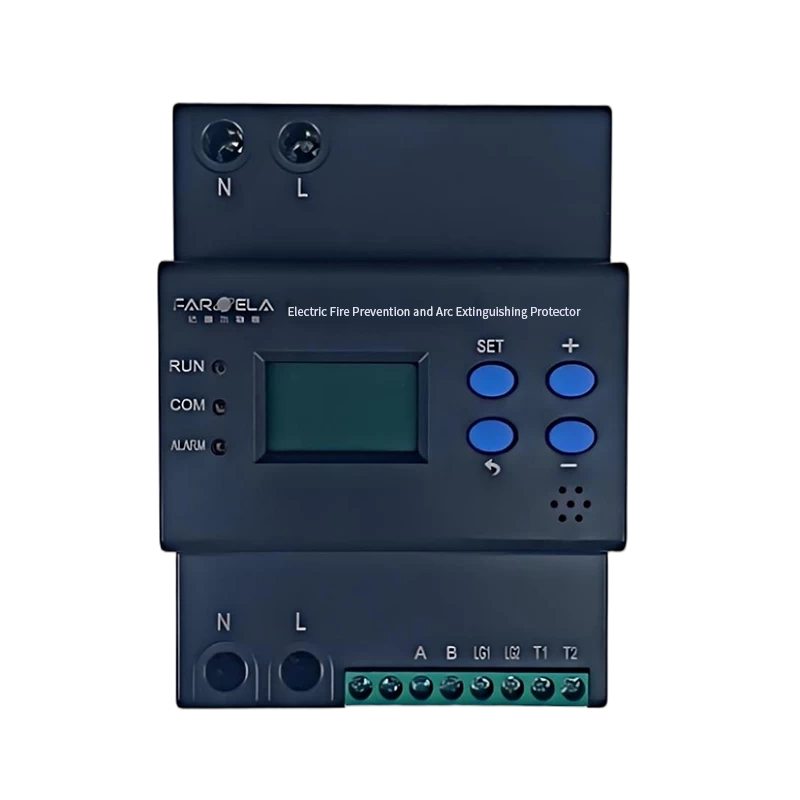
Electrical fires are rarely caused by a clean, dramatic short circuit. In most cases the sequence is slower and quieter: a loose terminal, a pinched cable behind a wall, a worn appliance cord. Current keeps flowing, a small arc forms, and the connection heats up over minutes or hours. Eventually surrounding material ignites. Neither a standard overcurrent breaker nor an earth leakage device reliably detects this condition - which is exactly why arc fault protection exists as a separate function.
1. What an Arc Fault Actually Looks Like
- Series arc: occurs in a single conductor - a broken strand, a loose screw terminal, a damaged cord. Current still flows through the load, often at normal levels, but the arc adds high-frequency noise and intermittent bursts of conduction.
- Parallel arc: occurs between two conductors or between a conductor and earth through damaged insulation. Current may be limited by the arc's own impedance, so it may stay below the overcurrent trip threshold while still generating intense local heat.
Both cases share a signature: high-frequency current components superimposed on the fundamental, and current that is intermittent rather than steady.
2. Why Ordinary Protection Misses It
- Overcurrent breakers respond to the magnitude and duration of current. A series arc at 5A on a 16A circuit never reaches the trip threshold.
- Earth leakage devices respond to current escaping to earth. A series arc in the live conductor leaks nothing to earth, and a parallel arc between live and neutral does not necessarily involve earth either.
An arc fault detection function fills this blind spot by analysing the high-frequency content and the timing pattern of the current waveform.
3. How Detection Works in Practice
The device continuously samples the current waveform and runs a detection algorithm looking for the characteristic spectral signature and intermittency of arcing. Because many normal loads also produce high-frequency noise, the algorithm has to discriminate: a vacuum cleaner motor, a dimmer and a switch-mode power supply all generate harmonics, but they do so steadily and repeatably, whereas arcing is irregular.
This discrimination problem is why real arc fault protection requires proper signal processing rather than a simple threshold, and why two devices with identical specifications can behave very differently in the field.
4. Applications: Where Arc Protection Pays for Itself
- Older buildings with aged wiring and aluminium conductors, where loose connections are common.
- Bedrooms and living areas where damaged flexible cords hide behind furniture.
- Wooden and timber-frame construction, where a hidden arc reaches combustible structure quickly.
- Solar PV and battery storage installations, where DC arcs do not self-extinguish at a zero crossing.
- Industrial control panels with vibration-loosened terminals.
5. Combined Devices: The Practical Approach for Distribution Boards
Fitting a separate device per circuit adds cost and panel space. Increasingly the practical answer is a device that combines overcurrent, leakage and arc fault functions, plus metering and remote monitoring. Benefits:
- One device per circuit means one clear point of responsibility when something trips.
- Combined sensing can use the same current transformer, reducing component count and cost.
- Integrated metering lets the same device report which circuit is degrading before it fails.
- Remote notifications turn a latent fire risk into a maintenance ticket.
Specification Checklist
- Which functions are genuinely integrated: overcurrent, leakage, arc fault, metering, remote control.
- Detection algorithm and the manufacturer's false-trip behaviour under common nonlinear loads.
- Rated current, poles and breaking capacity.
- Certification and test standard used for the arc fault function.
- Diagnostics: does the device indicate the type of fault so an electrician knows where to look?
- OEM/ODM support for protocol, branding and configuration.
Zhuhai Farrell Electronic Technology develops smart and safe electricity solutions combining protection, metering and remote control, including electric fire prevention and arc-extinguishing protectors for residential, commercial and industrial distribution. With in-house hardware and software development, we support full OEM/ODM programmes. Contact us for specifications, samples and integration support.